In Italy, the handbrake is pulled on the application of Green Public Procurement and the Minimum Environmental Criteria which, eight years after their entry into force, are struggling to take off in a structured manner*.
Out of a sample of 126 public administrations, including 14 Regional Purchasing Centres, 64 managing bodies of 148 protected areas, 41 Local Health Authorities and 7 Metropolitan Cities, in 2023 the average performance index of the sample surveyed is 62%, with a maximum value of 79% reached by Metropolitan Municipalities and a minimum value of 56% reached by the managing bodies of protected areas. The index represents an overall assessment of the implementation of policies required for GPP and the application of CAM. A sore point is the percentage of procurement monitoring, a practice carried out by only 17% of the sample. On the other hand, the best data concerns the ‘knowledge of Green Public Procurement’ which is now well established: for 98% of public administrations the knowledge and application of this tool is widespread, ensuring a first fundamental step towards its application; followed, among the best known and applied policies, are those on ‘Plastic free’ (57%) and ‘Training’ (56%); further behind, but equally important, are ‘Social Criteria’ (47%) and ‘Gender Procurement’ (46%).
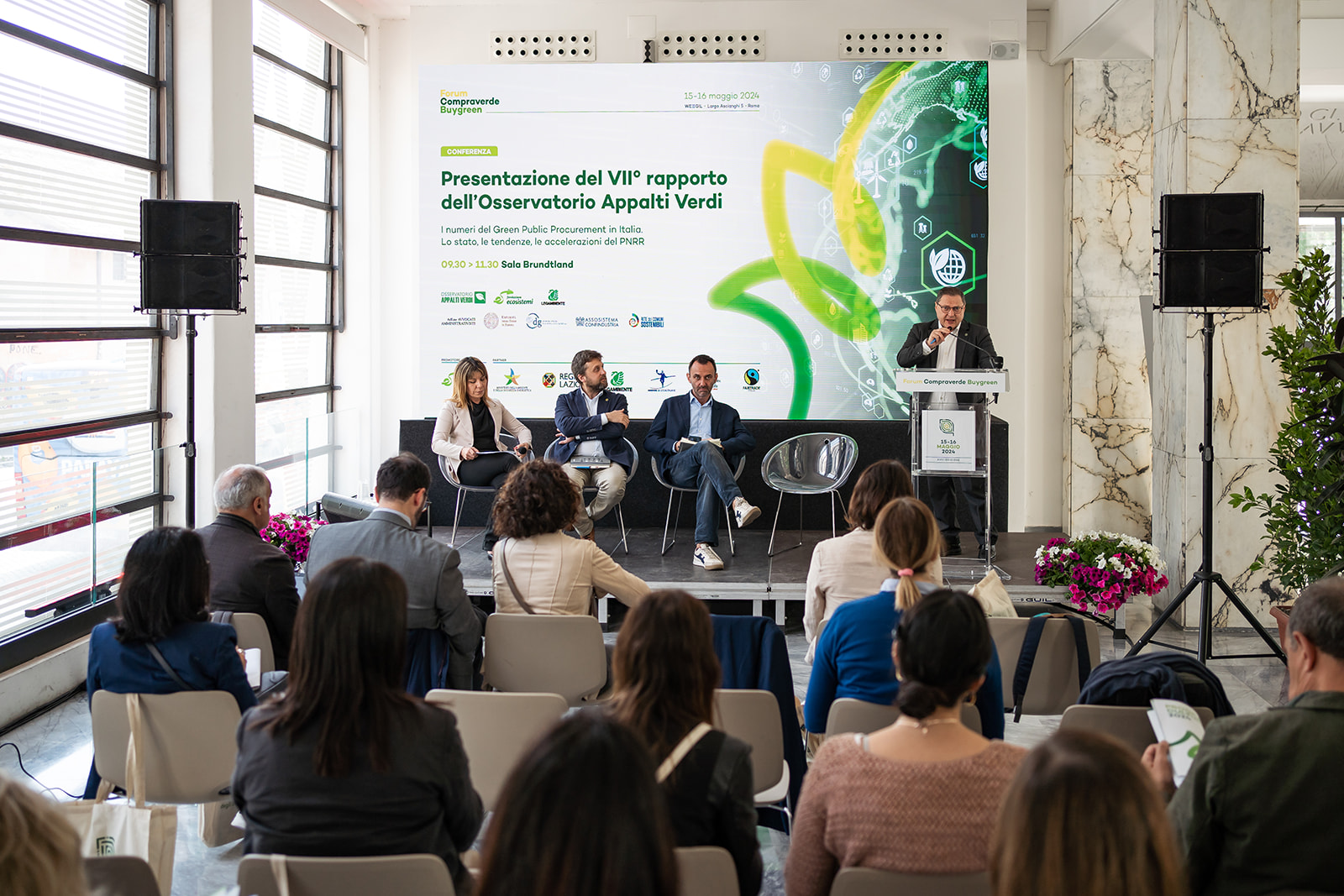
These are, in short, the main data of the VII 2024 report ‘The numbers of Green Public Procurement in Italy ’ by the Osservatorio Appalti Verdi di Legambiente and Fondazione Ecosistemi presented today in Rome at the Compraverde Buygreen 2024 Forum, now in its 18th edition. The aim of the report, in partnership with Assosistema, the University of Padua, AdLaw Avvocati Amministrativisti, the Department of Law of the University of Turin and the Rete dei Comuni Sostenibili, is to illustrate how Italy is facing up to the challenge of sustainability, which also includes purchases promoted by public administrations and the application of the Minimum Environmental Criteria.
Through the administration of an online questionnaire, 126 PAs responded on the application of the policies required for Green Public Procurement in tenders in 2023, including knowledge of the tool, staff training, plastic free and gender procurement, and on the adoption of the Minimum Environmental Criteria, which have been mandatory since 2016.
The delays of GPP and the actions to be put in place. Today in Italy, weighing on the delays in the application of GPP and especially CAM is, for 53% of the contracting stations interviewed, the difficulty of ‘drafting the notices’, followed by the ‘lack of adequate training’ (41%) and the lack of companies with suitable requirements (34%). Achilles heels on which it is important to intervene to speed up the pace and ensure full application by making up for lost time. This is why the Osservatorio Appalti Verdi (Green Procurement Observatory) asks that the main actions to start from concern, first and foremost, the training of competent and qualified personnel on the subject of CAM, followed by monitoring the outcome of tenders.
‘The overall data on the application of Green Public Procurement in Italy shows us that green procurement, although its usefulness is widely recognized, still suffers from too many slowdowns,’ says Andrea Minutolo, Legambiente’s scientific manager. The Green Procurement Observatory Report serves to pinpoint the weak points on which to intervene to make GPP more effective and practiced by PAs, so that it can become a structural tool. The promotion of an environmentally and socially preferable procurement system can really generate an improvement in environmental terms and the diffusion of green technologies.’
For Silvano Falocco, Director of Fondazione Ecosistemi, ‘The data in the Report highlight the urgency of strengthening the GPP tool with specific actions. Three actions are needed: each public administration must have a GPP contact person; a national programme is needed to train and support public administrations in the inclusion of environmental and social criteria; a national task force is needed to verify respect for human and social rights along the production chains, to avoid social dumping.’
Highlighted performance. Among all the performances monitored in the four contracting stations, a special mention to be made is the presence, in eight out of the total 64 protected area management bodies of a contact person for Green Public Procurement, as was requested in the proposals put forward in last year’s Report by the Green Procurement Observatory. Centralizing the practice of GPP through a more competent person who knows how to network the offices, is in fact one of the knots to be unraveled and insisted upon also for the dissemination and application of GPP in general.
Still on the side of the protected areas’ managing bodies, low percentages were recorded regarding the application of improved strategies for separate waste collection (only 39% put them into practice) and initiatives for energy saving and the creation of Renewable and Solidarity Energy Communities (only 44% promote them). Even though it is precisely the managing bodies of protected areas that should be an example and a stimulus for the public administration in promoting virtuous practices and good governance, including through the application of GPP.
Among the 41 local authorities that answered the Observatory’s questionnaire, there is a huge gap in the procurement monitoring system, with only 5% implementing it. A figure that raises a red light and calls for the search for useful solutions to understand how purchases are made and how spending can be rationalized, also in the light of the figures contained in the latest Economic and Financial Document that certifies healthcare spending of over 131 billion euro for the year 2023, with a healthcare spending/GDP ratio of 6.3%. These figures give us the order of magnitude and the importance of monitoring the health sector and understanding how spending can be channeled towards sustainability that concerns various purchases of the sector and the management of the health system.
In the light of everything, there are two priorities on which immediate action must be taken to enable a faster and more effective growth of GPP in our country. The greatest difficulty that public administrations still face today, in fact, concerns the lack of technical support for the drafting of tender documents, a fundamental aspect given that, for example, many CAMs do not provide for automatic application but require customization at the tender design stage, which is also necessary in some services (such as those on the energy management of buildings or public green). It is therefore necessary to equip each administration with specific, trained personnel who can direct and follow the procurement process in all its phases.
On the other hand, monitoring the state of Green Public Procurement adoption within individual contracting stations is still completely absent. This makes it impossible to properly evaluate the feedback of tendering procedures regarding the environmental criteria to be integrated. Again, monitoring is only realistically possible if a specific GPP contact person is identified, whose need and lack is felt. A contact person who should be the person able to connect the various policies of the administration (climate, mobility, circular economy and waste prevention action plans, urban regeneration plans, food councils, etc.) with the use of the GPP tool.
* In a context that sees, according to the latest data from Anac, a total value of public procurement initiated of €40,000 or more, which is around €283.4 billion.