
Reducing food waste and a plant-based diet alone would save between 150 and 200 billion tonnes of CO2 by 2050. Not surprisingly, a plate of meat produces on average about 50 times more emissions than a plate of legumes. The vast majority of the earth is in fact used to produce food of animal origin, causing deforestation in addition to the inevitable enteric emissions of the livestock life cycle.
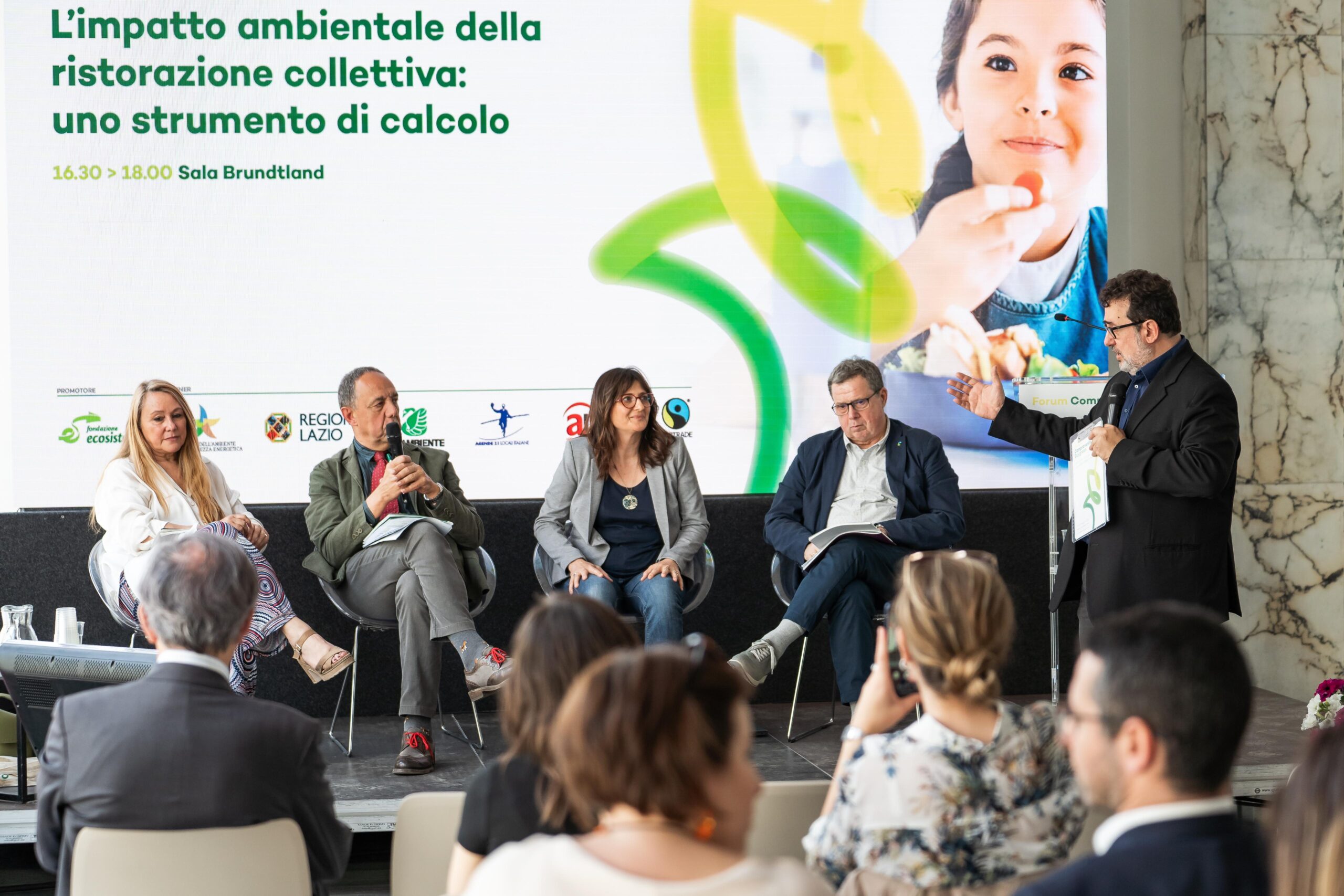
This is the picture taken during the Forum Compraverde Buygreen, the leading event in Italy and Europe, promoted by Fondazione Ecosistemi, for public and private green procurement policies, projects, goods and services.
According to a report by Project Drawdown, a non-profit organisation working to find solutions to climate change on a global level, of all the solutions, those involving food, agriculture and land use as a whole would contribute to more than 40% of the emission reductions needed by 2050.
Precisely because of the profound connections between food production, the environmental crisis and its most promising solutions, there is a need to develop tools to assess the impact of mass catering, highlighting the benefits of adopting healthy diets, reducing animal protein, and using sustainable and ecosystem-efficient agricultural practices.
To this end, Fondazione Ecosistemi has developed a mass food impact calculator which, in agreement with the World Resource Institute, takes into account the impact of the earth in an integral and effective manner, considering the ‘Carbon Opportunity Cost’. This tool makes it possible to estimate in an innovative way the effects of different agricultural practices, such as organic, natural grazing, or even whole-animal purchasing, short supply chain, and much more, in order to support contracting authorities in serving more sustainable meals.
Collective public catering in Italy represents a virtuous example compared to other European realities, also thanks to the minimum environmental criteria currently in force. However, it presents several critical issues and urgent needs for improvement. Public catering meals in Italy overwhelmingly contain animal food.
For example, in schools, meals in which the main protein is of vegetable origin, in the most virtuous situations, make up only 5-10% of the total, while they are often not on the menu at all. Moreover, despite the introduction of minimum environmental criteria on the management of food surpluses, good practices in this respect are still in the minority and food waste in canteens can exceed 40%.
Furthermore, in many cases, there is a lack of recognised specific certifications in the field of environmentally friendly farming techniques to enable contracting authorities to choose the most sustainable food.
The purpose of the calculator developed by Fondazione Ecosistemi, in addition to providing checklists of good practices, is precisely to evaluate mass catering meals in terms of several indicators, including greenhouse gases emitted, social and health impacts, biodiversity, water, epidemic risk, this with respect to many variables, such as type of farming practice, type of purchase, waste management, educational and communication activities. The tool, for example, is able to show that a plate of beef can have up to 13 times less impact if produced from local natural pasture rather than from intensive farming, or that introducing just two vegetable protein meals per month in an average primary school saves around 50 tonnes of CO2 equivalent per year. On the Italian scene, one of the obstacles that make change difficult, even small changes, is the lack of dialogue and interaction between the different actors involved in the catering industry.